Physical Therapy for Golfers Who Want to Play, Not Just Feel Better
If your body is limiting your golf, generic rehab is not enough. Golf PT at VIP PT connects your pain, your movement, and your swing so the plan makes sense for how you actually practice and play. One-on-one with a Doctor of Physical Therapy who has completed Titleist Performance Institute continuing education.
Golfers with pain during or after rounds Players who feel stiff, restricted, or “stuck” in the swing
Recurring back, hip, shoulder, elbow, wrist, or knee problems tied to golf
Golfers returning after an injury or surgery
Anyone who has been told to “rest and stretch” and is tired of it
Common golf complaints we help evaluate
Low back pain during or after golf
Golfer’s elbow or forearm pain
Shoulder pain during the swing
Hip mobility limitations
Knee discomfort with practice or walking the course
Loss of rotation or the feeling that the swing is “stuck”
Repeated flare-ups that never seem fully resolved
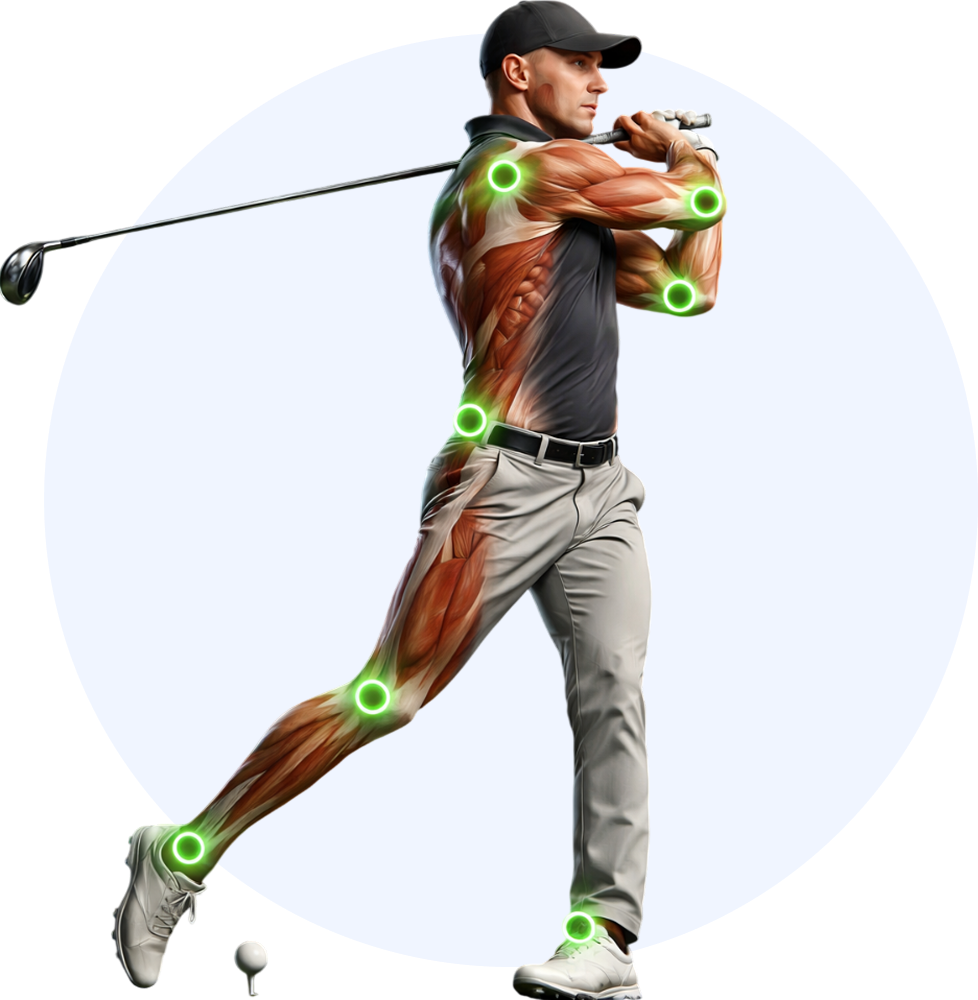
The golf problems we see most
Low back pain
The most common golf complaint. Usually the lower back is doing work the
hips and thoracic spine should be doing. We fix the rotation problem, not just the sore spot.
Golfer's elbow (medial epicondylitis)
Pain on the inside of the trail elbow, often from grip
pressure, casting, or hitting the ground before the ball. We treat the tendon and the swing load
that keeps irritating it.
Lead hip pain and restriction
The lead hip has to internally rotate and accept force at impact.
When it cannot, golfers early extend, slide, or overload the lower back.
Lead shoulder pain
The lead shoulder works across the body at the top of the backswing and
decelerates hard after impact. Rotator cuff, labral, and AC joint irritation are common.
Knee pain
Especially the lead knee, which takes rotational and shearing force through
impact, and any knee that hurts walking 18.
Wrist and hand pain
Lead wrist irritation from impact, hitting fat, or heavy range volume.
Choose Golf PT when pain, stiffness, or injury is the main problem.
Choose Golf Performance when you are not hurt and your goal is speed, mobility, strength, or durability.
Many golfers start with Golf PT and move into Golf Performance. The Golf Plus Package ($1,250, four weeks) is built for exactly that transition: 60 minutes of performance plus 30 minutes of physical therapy per visit.
Why golfers trust VIP PT
Golfers need more than “rest and stretch.” They need someone who understands the
difference between body mechanics and swing mechanics, who can tell you which one is the problem, and who will get you back on the course instead of telling you to stay off it. That is the
whole reason golf is the specialty here and not a side note.
Golf PT pricing
Initial Physical Therapy Evaluation
$225
Follow-up visit
$200
Session packages
5 for $950
8 for $1,400
12 for $2,000
HSA and FSA accepted
Superbills provided for out-of-network reimbursement.
GOT A QUESTION?
Frequently Asked Questions
Do I need to be a serious golfer for this to help?
No. Recreational golfers benefit just as much. If
pain or a movement limit is affecting your play, it is worth fixing.
Can I keep playing during Golf PT?
Usually, yes. Part of the plan is managing your practice and
play volume so you can keep golfing while the problem gets better. Stopping completely is
rarely the answer.
Will you only look at the painful area?
No. Golf pain almost always involves a limitation
somewhere else in the body. A sore lower back is usually a hip or thoracic spine problem first.
Can Golf PT help if I am not injured but feel limited?
Yes. If the limitation feels like a physical
restriction rather than a training goal, Golf PT is the right starting point. If it is a training goal,
start with Golf Performance.
What happens after the pain improves?
If performance goals remain, we move you into Golf
Performance. The plan is built for that transition from day one.
Do I need a referral?
No. Maryland allows direct access to physical therapy. If you plan to
submit a superbill to insurance, check whether your plan requires a referral for
reimbursement.
Get back to playing well
A 90-minute Golf PT evaluation with Dr. Smith is the first step.